
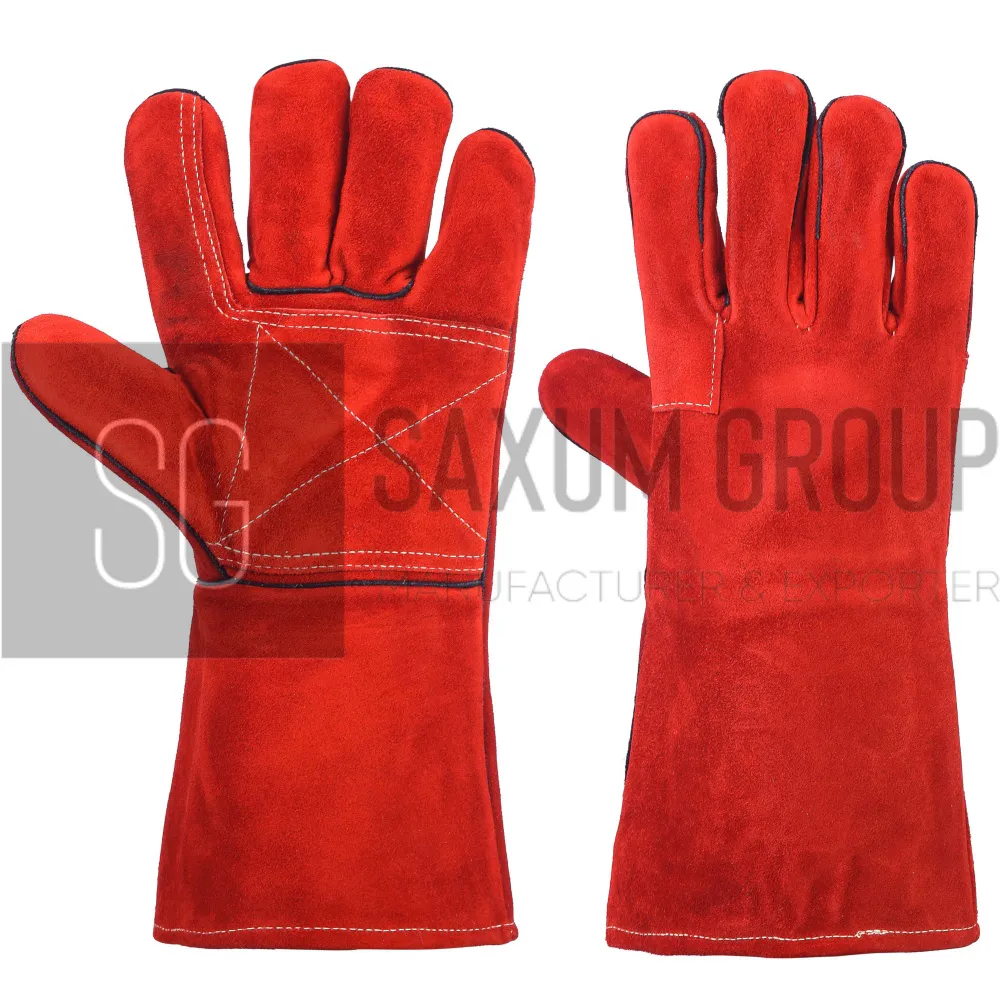
Stick welding is hard on gloves. The arc runs hot, the electrode throws heavy spatter, slag pops when it’s chipped, and the welder often works close to the puddle, out of position, for hours at a time. A glove that’s fine for light MIG work can be burned through or stiff as cardboard after a week on a stick job.
We make leather welding gauntlets for stick, MIG and TIG welders in our factory in Sialkot, Pakistan, for distributors and brands in the USA and Europe. This guide explains what stick welding gloves need to handle, which leather and construction details matter, and how to pick the right pair for a crew or a product range.
The short answer
- Stick welding gloves should be thick split cowhide gauntlets, heavier than MIG gloves and far heavier than TIG gloves.
- Choose a 14 to 16 inch gauntlet that overlaps the jacket sleeve, so spatter can’t fall into the gap.
- Look for Kevlar thread and welted seams, because thread fails before leather.
- A cotton or foam lining adds heat protection for high amperage and long runs.
- Trade-off: stick gloves give the most protection and the least feel. That’s fine for stick, but wrong for TIG.
What Stick Welding Does to a Glove
Stick welding, also called SMAW or shielded metal arc welding, uses a flux-coated electrode. Compared with MIG and TIG it usually means:
- More spatter. Larger, hotter droplets that land on the back of the hand and the cuff.
- High radiant heat. Heavy rods at high amperage push a lot of heat into the glove, especially on the hand closest to the arc.
- Slag. Chipping slag sends hot flakes flying, and hot slag can drop onto the glove.
- Rough handling. Stick welders often grip hot rod stubs, rough steel and the electrode holder all day.
- Outdoor and out-of-position work. Pipelines, structural steel and repairs mean overhead and vertical welds, where sparks fall straight down onto the hand and arm.
So a stick welding glove has to protect against heat and spatter first and give feel second. Our TIG vs MIG vs stick welding gloves comparison shows how the three processes change what a glove needs.
Leather: Split Cowhide Is the Standard
Most stick welding gloves are made from side split cowhide. Split leather is the inner layer of the hide. It’s thick, fibrous and tough, and it holds up well against heat and abrasion. Cowhide is the usual choice because it’s thicker than goatskin and pigskin, and it’s available in large pieces for gauntlet cuffs.
Thickness makes the biggest difference. A thicker palm and back slow heat getting through to the hand and survive spatter longer. The cost is stiffness: a heavy stick glove takes time to break in and doesn’t suit fine work. Our split vs grain leather gloves guide explains why split is used for stick and MIG while grain leather is used for TIG, and our cowhide vs goatskin gloves guide compares the hides.
Leather quality matters as much as thickness. Our Grade A vs Grade AB guide explains how to judge surface quality and consistency in welding leather.
Cuff Length: Go Long
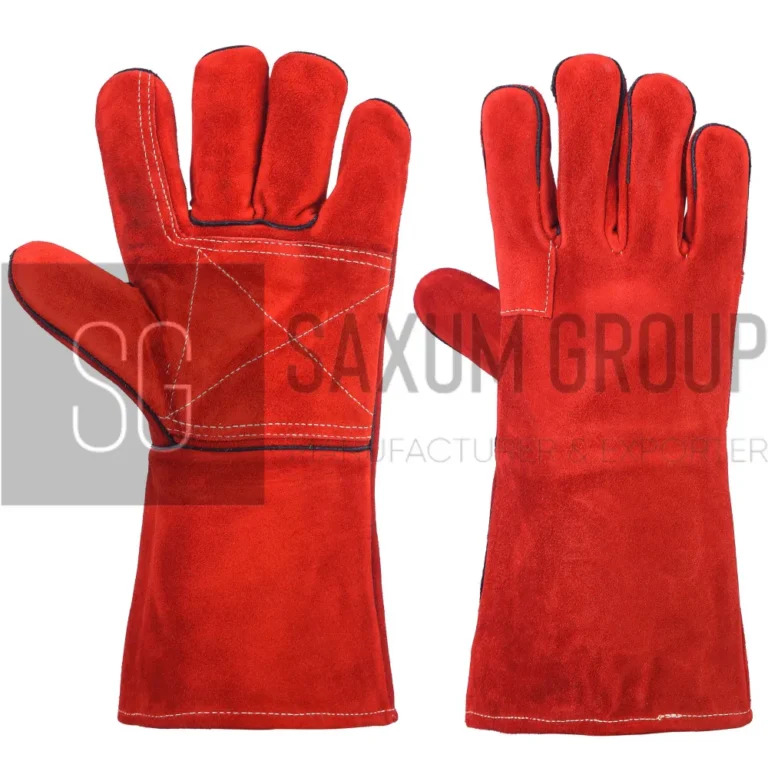
For stick welding, a gauntlet cuff is close to essential. A long cuff:
- Overlaps the welding jacket sleeve so spatter can’t fall into the gap at the wrist.
- Protects the forearm from radiant heat on long runs.
- Stays wide enough to shake the glove off fast if a spark gets inside.
Most stick welders use gloves around 14 inches long. For overhead work, pipeline work and heavy structural welding, 16 inches or longer gives extra cover. Our welding glove length guide explains how to choose, and our work glove cuff types guide compares gauntlets with other cuffs.
Thread, Seams and Welts
Ask anyone who has worn out welding gloves: the seams usually go first. A spark lands on a cotton or polyester stitch and burns through it, and the glove opens up while the leather around it is still fine.
- Kevlar thread resists heat far better than cotton or polyester. It’s the standard for good stick welding gloves.
- Welted seams have a strip of leather sewn into the seam. The welt covers the stitches and takes the heat and wear instead of the thread.
- Seam placement matters too. Gloves with fewer seams on the back of the hand, where spatter lands most, last longer.
Lining and Reinforcements
Lining
Many stick welding gloves are lined. A cotton or fleece lining adds comfort and soaks up sweat. A foam lining on the back of the hand adds extra heat protection against radiant heat from the arc. Some gloves add an aluminized back for very high heat. Lining makes the glove warmer and a little less flexible, so it suits high amperage and long runs more than short tack welds.
Reinforcements
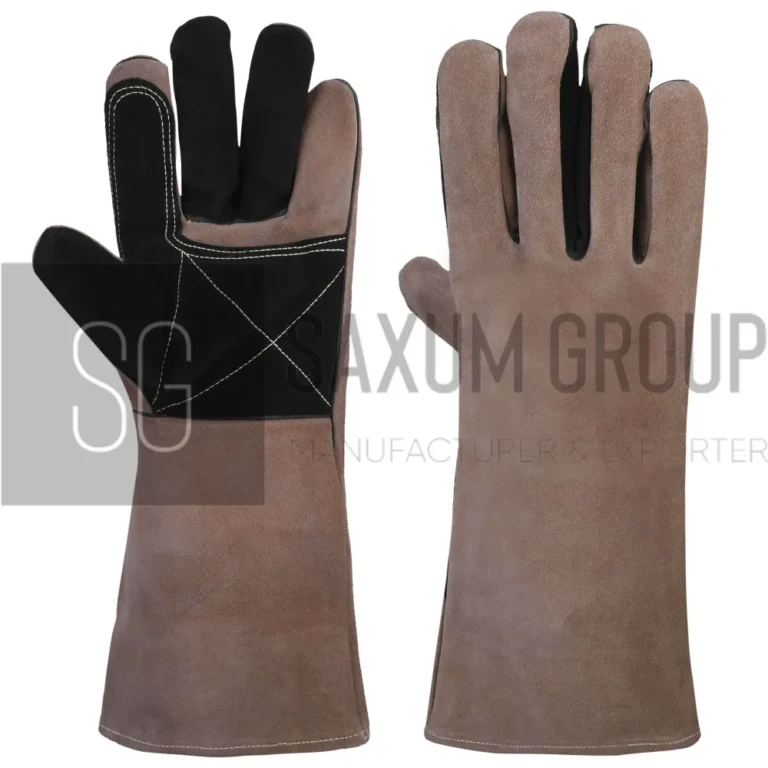
Reinforcement patches add a second layer where gloves wear out fastest:
- Palm patch for gripping the electrode holder and rough steel.
- Thumb crotch patch, where the glove flexes and rubs most.
- Back-of-hand or knuckle patch on the hand closest to the arc.
Our guide to heat resistant leather gloves covers linings and heat layers in more detail, and double palm work gloves explains how an extra palm layer adds life.
Stick vs MIG vs TIG Gloves Compared
| Feature | Stick (SMAW) | MIG (GMAW) | TIG (GTAW) |
|---|---|---|---|
| Usual leather | Thick split cowhide | Split cowhide, sometimes grain palm | Thin grain goatskin or cowhide |
| Heat and spatter protection | Highest | High | Low to medium |
| Dexterity | Lowest | Medium | Highest |
| Typical length | 14 to 16 inch gauntlet or longer | 13 to 14 inch gauntlet | Shorter cuff |
| Lining | Often lined | Lined or unlined | Usually unlined |
| Thread | Kevlar, welted seams | Kevlar, welted seams | Kevlar |
For more on the middle option, read our MIG welding gloves guide. For TIG, see the TIG welding gloves on our welding gloves page.
Can One Glove Do Stick and MIG?
Yes, for many welders. A heavy split cowhide MIG gauntlet with Kevlar thread and a lining will handle most stick work too, especially at moderate amperage. Shops that do mostly stick, heavy rod or overhead work are better served by a dedicated heavier glove, because it lasts longer and protects better under constant spatter.
The one glove that doesn’t cross over is TIG. A thin TIG glove won’t survive stick spatter, and a stick glove is far too thick for TIG filler control.
Fit and Sizing for Stick Welding Gloves
A heavy glove that’s too big is clumsy and tiring, and the fingers fold where they shouldn’t. One that’s too tight presses the leather against the skin, so heat gets through faster. Welders often prefer a little room in a stick glove for that reason, but not so much that grip suffers. Check our work glove size chart before ordering a size run.
Caring for Stick Welding Gloves
- Knock off spatter and slag after each shift rather than letting it build up.
- Dry damp or sweaty gloves at room temperature, never on a heater or near the arc.
- Don’t soak leather welding gloves in oil or heavy conditioner. Oily leather can catch fire more easily.
- Replace gloves with holes, burned-through seams or leather that’s gone hard and cracked.
Our guide on how to clean leather work gloves covers safe cleaning in more detail.
Stick Welding Gloves for Distributors and Private Label
For a welding supply range, stick gloves are a steady seller because they wear out and get replaced often. A practical line usually has a standard 14 inch split cowhide gauntlet, a heavier lined version for high amperage, and a long-cuff version for pipeline and overhead work. Keep MIG and TIG gloves next to them so buyers can step up or down.
When you brief a factory, spell out the leather, thickness, length, thread, welts, lining and patches. Our work glove tech pack guide shows how, and our custom logo work gloves and work glove packaging guides cover branding and retail packs.
Stick Welding Gloves: Frequently Asked Questions
What are the best gloves for stick welding?
Thick split cowhide gauntlets, around 14 inches or longer, sewn with Kevlar thread and welted seams. A lining adds heat protection for high amperage work.
Are stick welding gloves different from MIG gloves?
They’re similar in style, but stick gloves are usually heavier, longer and more often lined, because stick welding throws more spatter and heat. Many heavy MIG gloves work for stick too.
Can I use TIG gloves for stick welding?
No. TIG gloves are made from thin grain leather for feel. They don’t give enough protection against stick spatter and heat.
How long should stick welding gloves be?
Most welders use about 14 inches. Choose 16 inches or longer for overhead, pipeline and heavy structural welding, where sparks fall onto the arm.
Why do my welding gloves fall apart at the seams?
Usually the thread burns before the leather wears out. Gloves with Kevlar thread and welted seams last much longer under stick spatter.
Stick Welding Gloves From Our Range
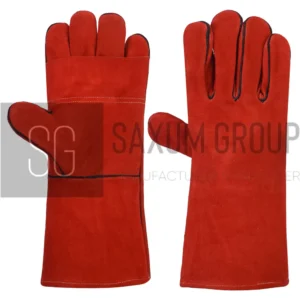
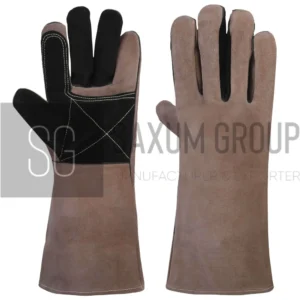
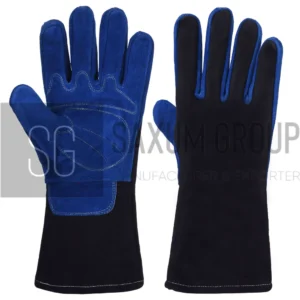
See the full work gloves range →
Wondering how much heat a stick glove can really take? Read what temperature can welding gloves withstand for the EN 407 levels in plain terms.
Heavy stick gauntlets are stiff when new. Our guide on how to break in leather work gloves includes safe methods for welding gloves, with no oil.
Stick gloves wear faster than any other welding glove. See how long welding gloves last and when to replace them.
Stick Welding Gloves Made in Sialkot, Pakistan
Saxum Group makes split cowhide welding gauntlets in a range of colors, lengths and reinforcements in our own factory in Sialkot. Browse our welding gloves, or see the full leather work gloves manufacturer in Pakistan range. We can make stick welding gloves to your spec, with your logo and packaging, through our private label service. Send your requirements through our contact page and you’ll get a quote within 24 hours. Buying from Pakistan for the first time? Read our guide to importing work gloves from Pakistan.