
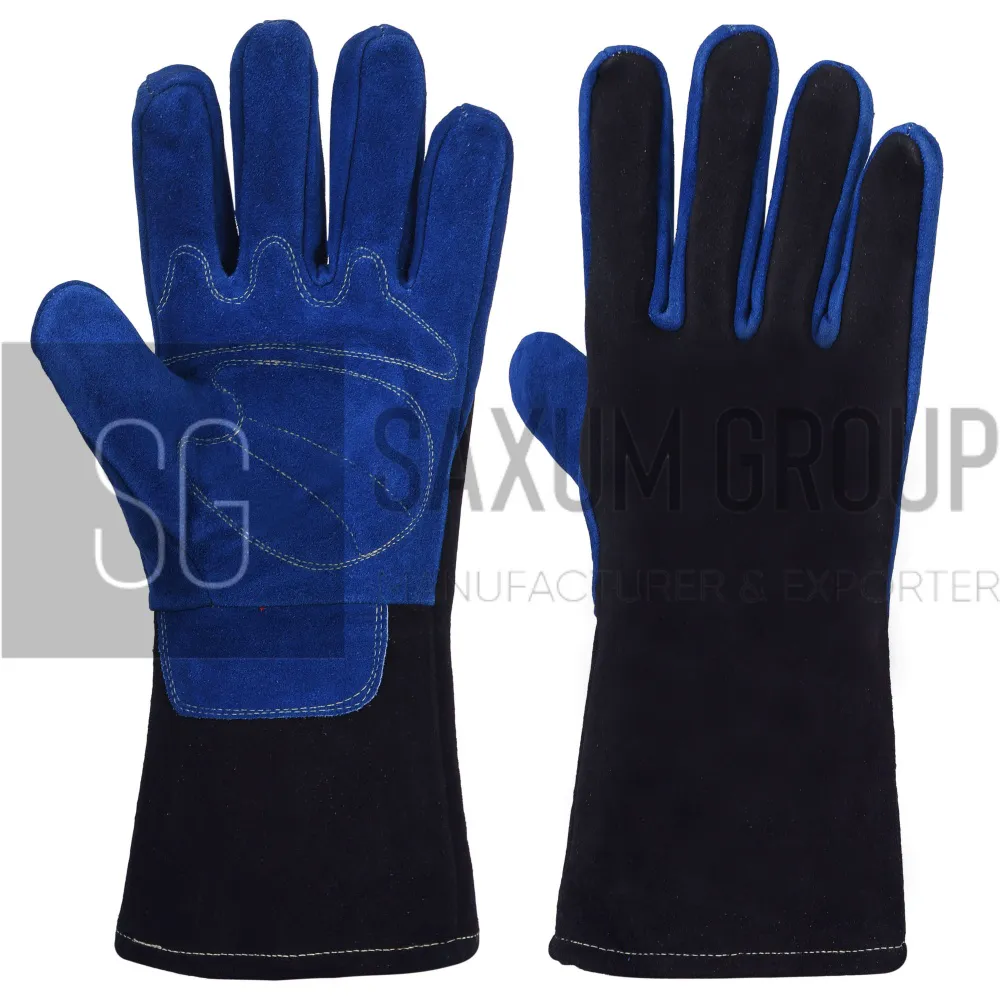
It’s one of the most searched questions about welding gear, and the honest answer surprises people: there isn’t one number. A welding glove doesn’t have a temperature it can “take” forever. What it has is a rating for how long it keeps your hand safe against a certain amount of heat, plus a material that behaves very differently from plastic or fabric when it gets hot.
We make leather welding gloves for MIG, TIG and stick welders in our factory in Sialkot, Pakistan, for buyers in the USA and Europe. This guide answers what temperature welding gloves can withstand, in plain terms: how heat ratings work, what happens to leather when it gets too hot, whether welding gloves are fireproof, and how to choose a glove for hot work.
The short answer
- Heat protection in gloves is usually rated with EN 407. Its contact heat levels are tested at 100°C (212°F), 250°C (482°F), 350°C (662°F) and 500°C (932°F).
- Each level means the glove keeps the inside from warming more than 10°C for at least 15 seconds of contact. It’s short protection, not all-day protection.
- Leather doesn’t melt. It chars and stiffens, which is why it’s the standard for welding gloves.
- No welding glove is fireproof. Good ones are flame resistant and slow heat down.
- Thicker leather, a lining and an aluminized back raise heat protection. Kevlar thread keeps the seams from failing first.
Why There’s No Single Temperature for Welding Gloves
A welding arc runs at thousands of degrees, far hotter than any glove could survive in direct contact. Welding gloves work because the hand is never in the arc. What reaches the glove is a mix of:
- Radiant heat from the arc and the hot workpiece.
- Spatter: small drops of molten metal that land and cool on the leather.
- Contact heat from touching or holding hot metal, rods and clamps.
Each one tests a glove in a different way, so a single “maximum temperature” would be misleading. Ratings measure each kind of heat separately, and they measure time, not just temperature.
What Temperature Can Welding Gloves Withstand? The EN 407 Levels
EN 407 is the European standard for heat and flame protection in gloves, and it’s widely used to compare welding and heat gloves sold in the USA too. The welding glove standard EN 12477 builds on it. The part most people care about is contact heat:
| Contact heat level | Test temperature | What it means |
|---|---|---|
| Level 1 | 100°C (212°F) | At least 15 seconds before the inside warms by 10°C |
| Level 2 | 250°C (482°F) | At least 15 seconds before the inside warms by 10°C |
| Level 3 | 350°C (662°F) | At least 15 seconds before the inside warms by 10°C |
| Level 4 | 500°C (932°F) | At least 15 seconds before the inside warms by 10°C |
So a glove with contact heat level 2 doesn’t mean you can hold a 250°C part all shift. It means you get a short, safe window to grab it, move it and let go. For longer contact you need a higher level, a thicker lining, or a tool instead of your hand.
EN 407 also rates burning behavior, convective heat, radiant heat and molten metal splash. Our heat resistant leather gloves guide explains all six digits of the code.
One important point: a glove only has a rating if it has been tested. The leather type alone doesn’t give it a number. If you need a rated glove, ask for the test report.
What Happens to Leather When It Gets Too Hot
This is why welders trust leather. Synthetic fabrics like nylon and polyester soften and melt when hot, and molten plastic sticks to skin. Leather doesn’t melt. When it gets too hot it:
- Dries out and stiffens, often curling or shrinking slightly.
- Darkens and chars on the surface.
- Cracks and burns through only after a lot of heat or repeated hits in the same spot.
That slow failure gives the welder time to notice and react. It’s also why gloves that have gone hard and cracked from heat should be replaced. They’ve lost much of their protection. Our leather vs synthetic work gloves guide compares the two materials in more detail.
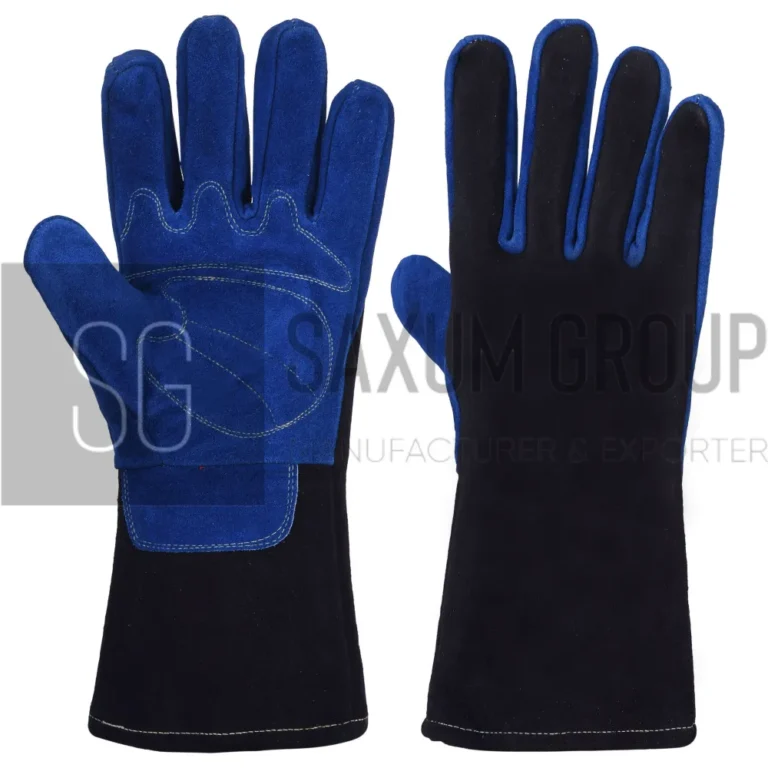
Are Welding Gloves Fireproof?
No. “Fireproof” suggests a glove that can’t burn, and no leather glove is like that. Welding gloves are flame resistant: leather is slow to catch fire, tends to stop burning when the flame is removed, and doesn’t drip. With enough heat for long enough, any glove will char and eventually burn through.
A few things make welding gloves less flame resistant, and they’re worth avoiding:
- Oil and grease. Oily leather catches fire more easily. Don’t treat welding gloves with oil or heavy conditioner. Our guide on how to break in leather work gloves covers safe ways to soften them.
- Synthetic parts. Nylon thread, plastic labels and synthetic linings can melt even when the leather is fine.
- Worn, thin spots. Leather that’s worn thin heats through much faster.
What Makes One Welding Glove Handle More Heat Than Another
Leather thickness
Thicker leather slows heat down. Heavy split cowhide gauntlets handle more heat than thin grain leather TIG gloves, which trade protection for feel. Our split vs grain leather gloves guide explains the difference.
Lining
For contact heat, the lining often does more than the leather. Cotton, fleece, foam and aramid felt linings all add time before heat reaches the hand. Many stick welding gloves are lined for this reason.
Aluminized back
An aluminized layer on the back of the hand reflects radiant heat from the arc or a furnace. It helps a lot against radiant heat, less against contact heat.
Kevlar thread and welts
Thread usually fails before leather. Kevlar thread resists heat far better than cotton or polyester, and leather welts cover the seams from spatter. See our MIG welding gloves guide for how these are built.
Cuff length
A long gauntlet keeps spatter and radiant heat off the wrist and forearm. Our welding glove length guide explains how long is long enough.
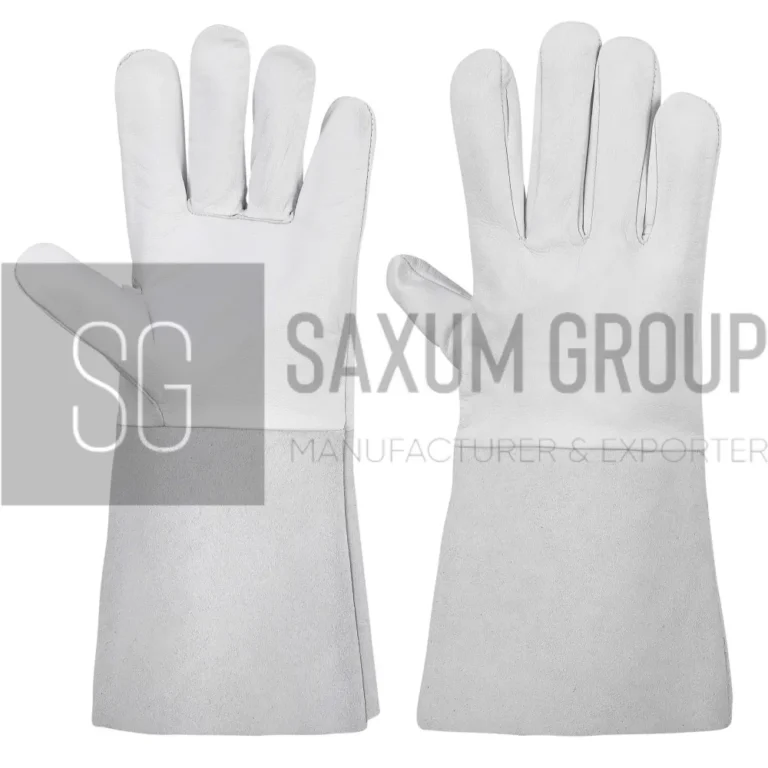
Which Welding Glove for Which Heat
| Work | Main heat | Glove to look for |
|---|---|---|
| TIG welding | Low spatter, some radiant heat | Thin grain goatskin or cowhide TIG glove |
| MIG welding | Spatter and radiant heat | Split cowhide gauntlet, Kevlar thread, welts |
| Stick welding, high amperage | Heavy spatter, high radiant heat | Thick lined split cowhide gauntlet, 14 to 16 inch |
| Handling hot parts | Contact heat | Lined glove with a tested contact heat level |
| Furnace and foundry work | Radiant heat, molten splash | Aluminized back, heavy lining, long cuff |
Not sure which welding style fits? Our TIG vs MIG vs stick welding gloves guide compares them side by side.
For Buyers: Heat Ratings and Private Label Gloves
If you sell welding gloves under your own brand, only print a heat rating the glove has actually been tested to, and keep the test report on file. When you brief a factory, state the heat type, the job and any rating you need, along with leather thickness, lining and thread. Our work glove tech pack guide shows how to write that spec, and the ANSI cut levels guide covers cut ratings if you need both.
Welding Glove Temperature: Frequently Asked Questions
What temperature can welding gloves withstand?
It depends on the rating. Under EN 407, contact heat levels are tested at 100°C, 250°C, 350°C and 500°C, and each level means at least 15 seconds of protection at that temperature. A glove without a test result has no official number.
Are welding gloves fireproof?
No glove is fireproof. Leather welding gloves are flame resistant: they char instead of melting and are slow to catch fire, but enough heat will burn through them.
Can I pick up hot metal with welding gloves?
Briefly, yes, if the metal is within the glove’s contact heat rating. For long holds or very hot parts, use pliers, tongs or a glove with a higher contact heat level.
Are TIG gloves as heat resistant as MIG gloves?
Usually not. TIG gloves use thinner leather for feel, so they slow heat less. They suit TIG because there’s little spatter, but they’re not meant for heavy MIG or stick work.
Why do my welding gloves get hard and crack?
Heat dries out leather over time. Gloves that are often exposed to high heat, dried near heaters or soaked and dried quickly go stiff and crack. Replace gloves once the leather cracks through.
Welding Gloves From Our Range
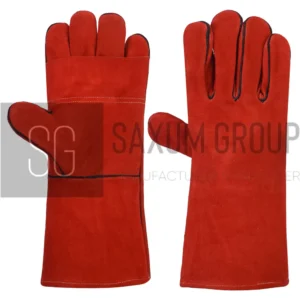
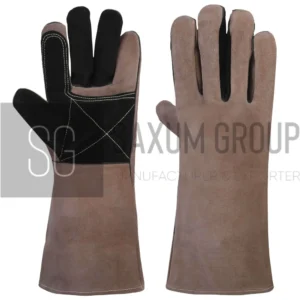
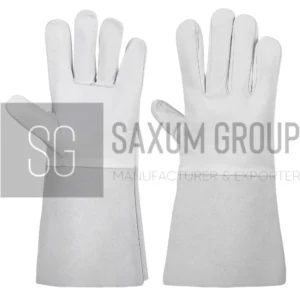
See the full work gloves range →
Heat is the main reason welding gloves wear out. Our guide on how long do welding gloves last lists the signs that a pair has lost its protection.
Leather Welding Gloves Made in Sialkot, Pakistan
Saxum Group makes split cowhide welding gauntlets, lined gloves and grain leather TIG gloves in our own factory in Sialkot. Browse our welding gloves or the full leather work gloves manufacturer in Pakistan range, and ask about lining, thread and cuff options through our private label service. Send your requirements through our contact page and you’ll get a quote within 24 hours.