
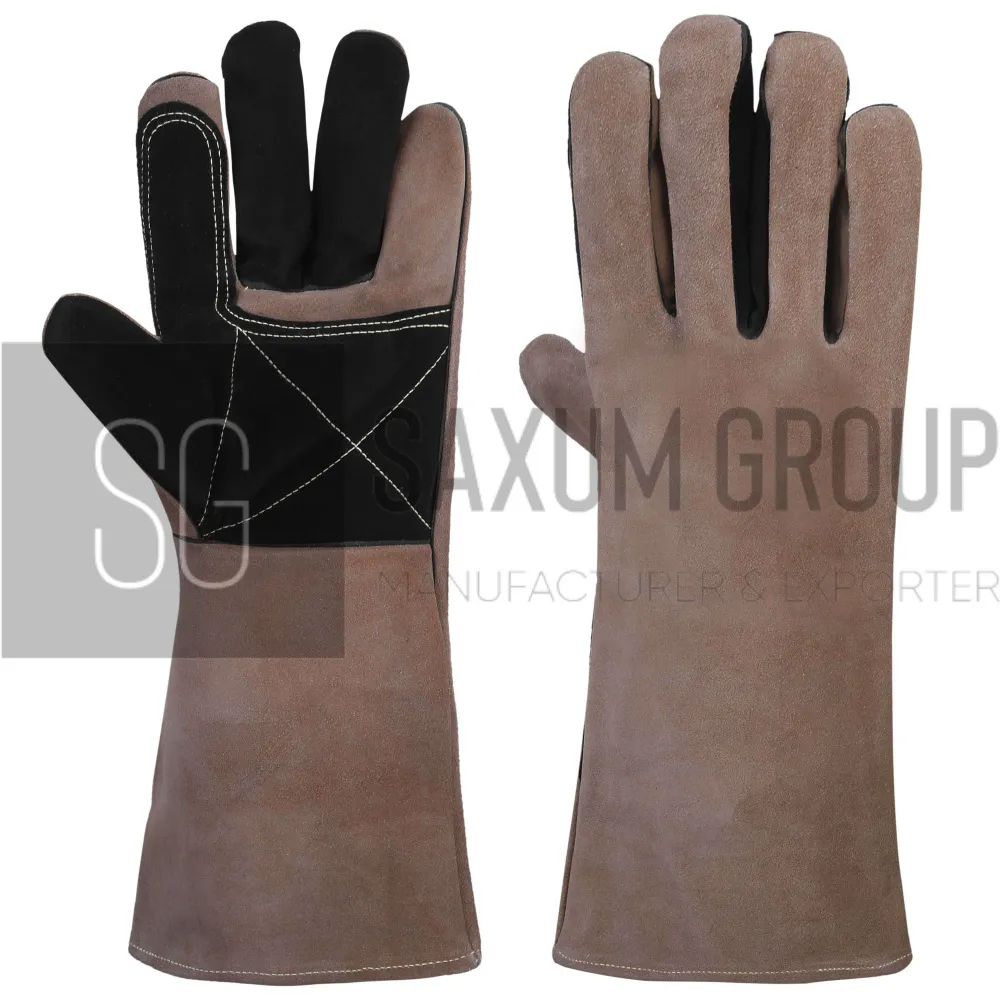
“Heat resistant” is printed on a lot of glove packaging, and it can mean almost anything. A cotton glove that lets you grab a warm pipe for two seconds gets the label. So does a lined gauntlet that holds up against molten metal splash. Same words, very different gloves. If you buy or resell heat resistant leather gloves, the real question is: resistant to what kind of heat, how hot, and for how long?
We make leather welding gloves, heat resistant mittens and aluminized gloves in Sialkot, Pakistan, for distributors and brands in the USA and Europe. This guide covers what our buyers ask us most often: how heat actually reaches the hand, what the EN 407 numbers mean, and how leather, linings, thread and aluminized fabric each change what a glove can handle.
The short answer
- Heat resistant leather gloves are rated by EN 407. The second digit (contact heat) runs from level 1 at 100°C to level 4 at 500°C, for at least 15 seconds of protection.
- Split leather with a cotton, foam or wool lining is the usual choice for welding and handling hot parts.
- Kevlar thread keeps the seams from burning through. Cotton thread chars and polyester melts.
- For furnace and foundry work with strong radiant heat, aluminized gloves reflect the heat better than plain leather.
Three Kinds of Heat, Three Different Problems
Before comparing gloves, it helps to know how heat gets to the hand. There are three routes, and a glove that’s good at one can be poor at another.
- Contact (conductive) heat. You touch or hold something hot: a fresh weld, a hot mould, a tray out of an oven. Heat moves straight through the glove into your skin. Thickness and lining do most of the work here.
- Convective heat. Hot air or flame rising around the hand, like when you reach over a furnace or work above a torch. The glove needs to slow down heat soaking in from all sides.
- Radiant heat. Heat that travels as infrared from a very hot source, such as a furnace mouth or molten metal, without touching you at all. Thick leather slows it down, but a shiny surface that reflects it away works far better.
On top of these, there’s spatter and molten metal splash, which is a mix of contact heat and burn-through. A glove can feel fine against hot air and still let a drop of molten steel burn straight through a thin seam.
What EN 407 Ratings Mean on Heat Resistant Gloves
EN 407 is the European standard for gloves that protect against heat and flame, and it’s the clearest way to compare one heat resistant glove with another. Many US buyers ask for it too, because it gives every glove the same six tests. The rating appears as six digits under a flame pictogram, each from 1 to 4 (or X if that test wasn’t done, or 0 if the glove failed it):
| Digit | What it tests | What a higher number means |
|---|---|---|
| 1 | Limited flame spread | The glove stops burning and glowing sooner after a flame is taken away |
| 2 | Contact heat | The glove holds back a hotter surface for at least 15 seconds |
| 3 | Convective heat | Longer delay before heat from flame passes through |
| 4 | Radiant heat | Longer delay before radiant heat passes through |
| 5 | Small splashes of molten metal | More drops needed to raise the inside temperature by 40°C |
| 6 | Large quantities of molten metal | More molten iron needed to damage a skin simulant behind the glove |
The contact heat digit is the one most people care about, and its levels are easy to remember:
- Level 1: 100°C
- Level 2: 250°C
- Level 3: 350°C
- Level 4: 500°C
In each case the glove has to keep the inside from warming by more than 10°C for at least 15 seconds. That’s a key point: 15 seconds. A contact heat level 2 glove doesn’t mean you can hold a 250°C part all day. It means you get a short, safe window to pick it up and put it down. For anything longer, you need more insulation, a better grip technique, or a tool.
Under the 2020 version of the standard, a glove that hasn’t passed the flame spread test is shown with a slightly different pictogram, so buyers can tell at a glance whether the glove was tested for direct flame. If you’re writing a spec, ask for the full six-digit code and the test report, not just the words “heat resistant”. Our guide to ANSI cut levels explains how the US standard rates gloves for cut, which is often listed next to the heat rating.
Why Heat Resistant Leather Gloves Still Beat Synthetics
Leather doesn’t melt. That one fact explains why it’s still the first choice for welding and hot work, even with all the new synthetic fabrics around. Nylon, polyester and many coated gloves soften and stick to the skin when they get hot enough. Leather chars and stiffens instead, which gives the wearer time to pull away.
Not all leather behaves the same, though:
- Split cowhide is thick and fibrous, with a lot of air trapped between the fibers. That makes it a good insulator, and it’s why heavy MIG and stick welding gauntlets are almost always split leather. It’s also cheaper than grain.
- Grain leather (cowhide or goatskin) is denser and smoother. It’s tougher against abrasion and gives better feel, but at the same thickness it insulates a little less. That’s why TIG gloves, which are thin for control, aren’t meant for heavy heat.
- Thickness matters more than type. A 1.3 mm split leather glove and a 1.0 mm one can look identical on a shelf. Under a hot weld, the difference is obvious within seconds.
Cowhide is the usual base for heat resistant welding gloves because it’s thicker. Goatskin is softer and more flexible, and it suits lighter work. Our cowhide vs goatskin work gloves comparison covers the difference in detail. For hot jobs that also wear out the palm fast, such as handling rough castings, a second layer of leather on the palm adds both insulation and life. That’s the idea behind double palm work gloves.
Leather has limits. Long exposure to high heat dries it out, shrinks it and makes it brittle. Once that happens the glove cracks and loses most of its protection. Proper care slows this down, and our guide on how to clean leather work gloves covers how to dry and condition them without making the problem worse. For a full side-by-side of the two leather types, see split vs grain leather gloves.
Linings: Where Most of the Insulation Comes From
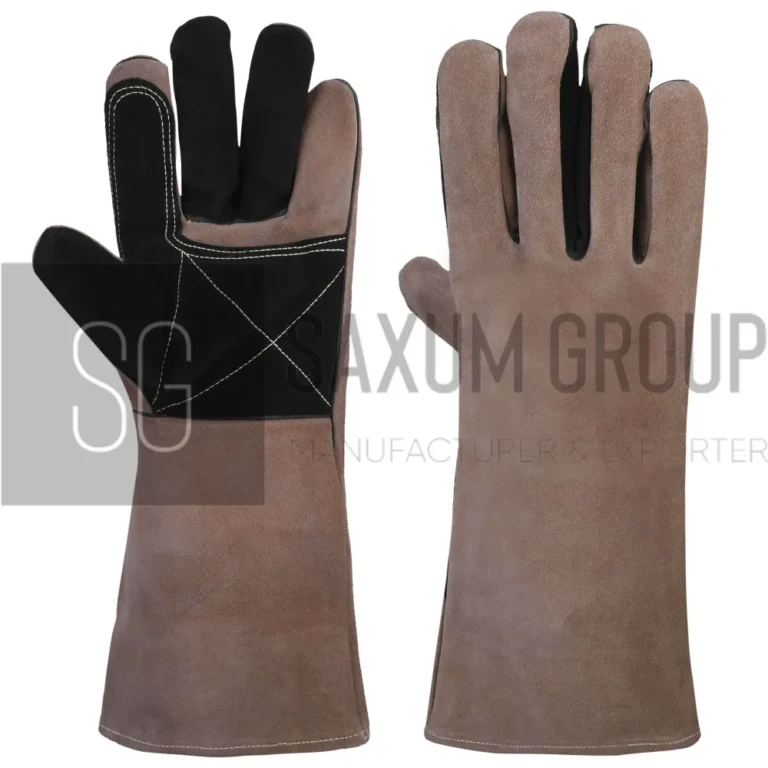
Leather on its own only goes so far. For contact heat in particular, the lining often does more than the shell. The common options:
- Cotton or fleece lining. Soft and comfortable, adds moderate insulation, and soaks up sweat. Standard in most welding gauntlets.
- Foam lining. Lighter, with good insulation for its weight. Often used in the back of the hand on welding gloves, where radiant heat hits hardest.
- Wool or wool blend. Insulates well and stays warmer when damp. Common in heavy heat resistant mittens.
- Aramid (Kevlar) felt or knit. Doesn’t melt and holds up at high temperatures. Adds heat and cut resistance together, at a higher cost.
One thing people forget: every layer of lining costs some dexterity. A heavily lined glove is great for lifting hot castings and awful for feeding filler wire. That’s the trade-off you’re always balancing, and it’s why most welding shops keep more than one type of glove. Our comparison of TIG vs MIG vs stick welding gloves goes through that balance process by process.
Kevlar Thread vs Cotton Thread
A glove is only as heat resistant as its seams. You can have thick, well-lined leather, and the glove still fails at the stitching because the thread burned through.
Cotton thread chars and weakens near hot spatter and hot surfaces. Polyester thread is worse, as it melts. Kevlar (aramid) thread doesn’t melt and keeps its strength at temperatures where cotton has already given up. That’s why buyers of serious welding gloves and heat resistant gloves usually ask for Kevlar stitching.
It costs more than cotton, so on a quote it’s one of the first things a price-focused supplier quietly swaps out. If heat is the whole point of the glove, make the thread part of your written spec and check it on the sample. Welted seams, where a strip of leather is sewn into the seam, also help by keeping the thread away from direct heat and wear.
Aluminized Gloves for Radiant Heat
When the heat is mostly radiant, leather alone isn’t the best answer. Foundries, glass plants, furnace work and some firefighting jobs use aluminized gloves instead: a heat resistant base fabric, often aramid, with a thin reflective aluminum layer bonded to the outside.
The shiny surface reflects most of the radiant heat before it can be absorbed, so the hand inside stays cooler for much longer than it would in plain leather. Many aluminized gloves still use a leather palm, because aluminized fabric isn’t great for grip or abrasion. The back of the hand, which faces the heat source, gets the reflective layer.
What aluminized gloves don’t do well is contact heat. Grip a hot bar in one and the thin fabric conducts heat fairly quickly, unless there’s a thick lining underneath. So the right choice depends on the job: reflecting heat from a furnace is a different task from holding a hot part.
One Finger and Five Finger Heat Resistant Mittens
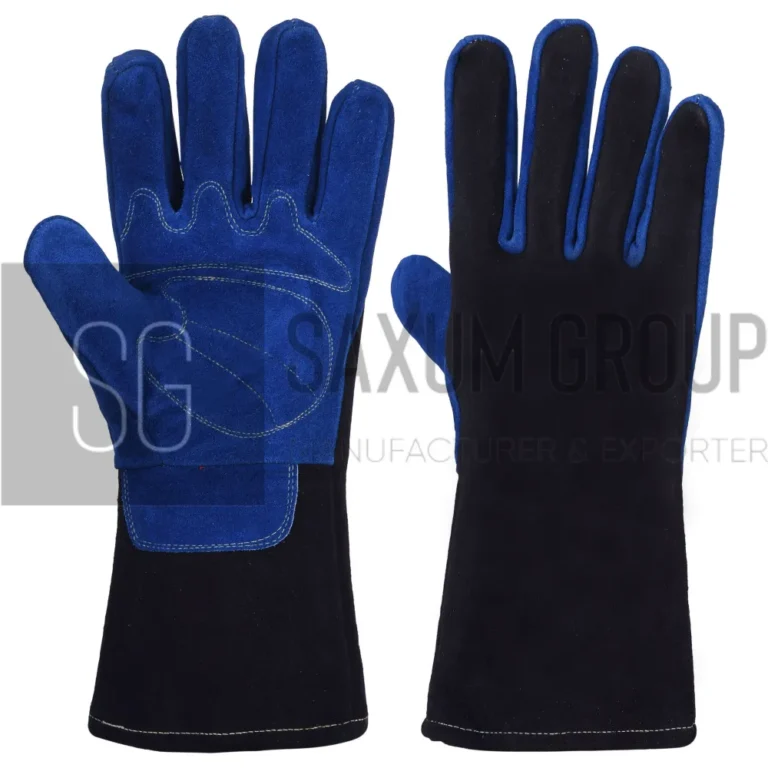
For the hottest handling jobs, foundries often skip fingers altogether. A one finger mitten (thumb, index finger and a mitten for the other three) keeps three fingers together, so they share warmth and the insulation stays thicker. There are fewer seams to fail, and more room for a heavy lining.
The cost is dexterity. You can grip a handle or a ladle, but you can’t do fine work. Five finger heat resistant gloves give more control with a little less insulation, and they suit jobs like moving hot parts, handling moulds and maintenance near furnaces.
Long cuffs matter here as much as the hand. Molten metal and hot spatter love to drop into the gap between glove and sleeve. A cuff of 14 to 18 inches covers the forearm. Our welding glove length guide explains how to match cuff length to the job. Above the cuff, the arm and body need cover too, and leather welding aprons and sleeves close that gap. If you’re choosing a jacket, our leather welding jacket vs FR cotton jacket guide compares the two.
Matching the Glove to the Job
| Job | Main heat type | A sensible starting point |
|---|---|---|
| MIG and stick welding | Spatter, radiant, some contact | Lined split leather gauntlet, Kevlar stitching, welted seams |
| TIG welding | Light radiant, little spatter | Thin grain leather TIG glove, unlined or lightly lined |
| Handling hot parts and castings | Contact | Heavily lined leather glove or one finger mitten, long cuff |
| Furnace, foundry and glass work | Radiant, molten metal splash | Aluminized back with leather palm, or full aluminized glove |
| Ovens, kilns and industrial bakeries | Contact, short duration | Lined leather or aramid glove with a tested contact heat level |
These are starting points, not a substitute for a site risk assessment. The people who know the actual temperatures and contact times are the safety team on site, and the glove should be chosen around their numbers.
What to Put in a Spec When You Source Heat Resistant Leather Gloves
If you’re a distributor or a brand building your own range, a vague request gets you a vague glove. These are the details worth writing down:
- The heat type and the job. “Foundry, handling castings around 300°C” tells a factory far more than “heat resistant”.
- Target EN 407 code if you need certification, plus whether you’ll need a test report from an accredited lab.
- Leather type and thickness: split or grain, cowhide or goatskin, and a thickness range in millimeters.
- Lining material, and whether it covers the full hand or only the back.
- Thread: Kevlar or cotton, and whether you want welted seams.
- Cuff length and style: safety cuff, gauntlet or extended cuff, in inches or centimeters.
- Sizes, branding and packaging: your size run, logo position and labels. Our custom logo work gloves guide covers the branding options.
Then ask for a sample and test it in the real job before you place a bulk order. Wear it, weld in it, pick up the hot part. A glove that looks right in a photo and a glove that works on the shop floor aren’t always the same glove.
Heat Resistant Gloves: Frequently Asked Questions
How hot can heat resistant leather gloves handle?
It depends on the rating, not the word on the label. A glove with EN 407 contact heat level 2 keeps the inside cool enough for at least 15 seconds against a 250°C surface. Level 4 is tested at 500°C. Those are short contact times, so for long handling of hot parts you need a thicker lining, a mitten or a tool.
Are welding gloves the same as heat resistant gloves?
Welding gloves are one type of heat resistant glove, built mainly for spatter, sparks and radiant heat from the arc. They aren’t always made for long contact with hot metal. A lined MIG gauntlet handles both reasonably well. A thin TIG glove does not, and it shouldn’t be used for lifting hot parts.
Is goatskin or cowhide better for heat?
At the same thickness they’re close, but cowhide is usually cut thicker, so split cowhide gauntlets insulate better. Goatskin is chosen for feel and flexibility, which is why it’s popular in TIG gloves and driver gloves.
Do heat resistant gloves protect against cuts too?
Not automatically. Heat and cut are tested separately. A leather glove with an aramid lining can do both, and its cut rating will be shown under ANSI/ISEA 105 or EN 388 if it was tested.
How long do heat resistant leather gloves last?
That depends on how hot and how often. Once the leather goes hard, shrinks or cracks, the glove has lost much of its protection and should be replaced. Drying gloves slowly, away from direct heat, makes them last noticeably longer.
Heat Resistant Welding Gauntlets From Our Range
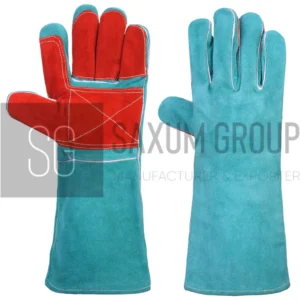
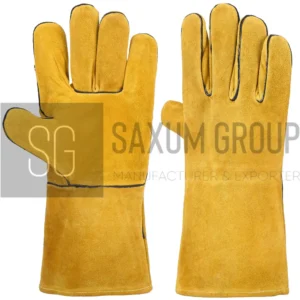
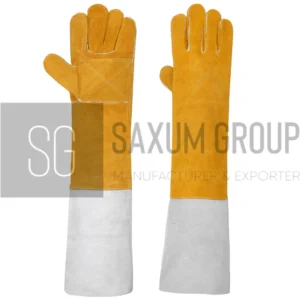
See all leather welding gloves →
Heat Resistant Leather Gloves Made in Sialkot, Pakistan
At Saxum Group we make welding gauntlets, heat resistant mittens in one finger and five finger styles, and aluminized gloves for radiant heat, all to order in our own factory in Sialkot. As a leather work gloves manufacturer in Pakistan and a welding clothing manufacturer, we can match your sample or build a heat resistant glove to your spec, with your logo and packaging through our private label service. Send us a photo, a sample or a spec through our contact page and you’ll get a quote within 24 hours. If you’re new to sourcing from here, our guide to importing work gloves from Pakistan walks through the process for buyers in the USA.