
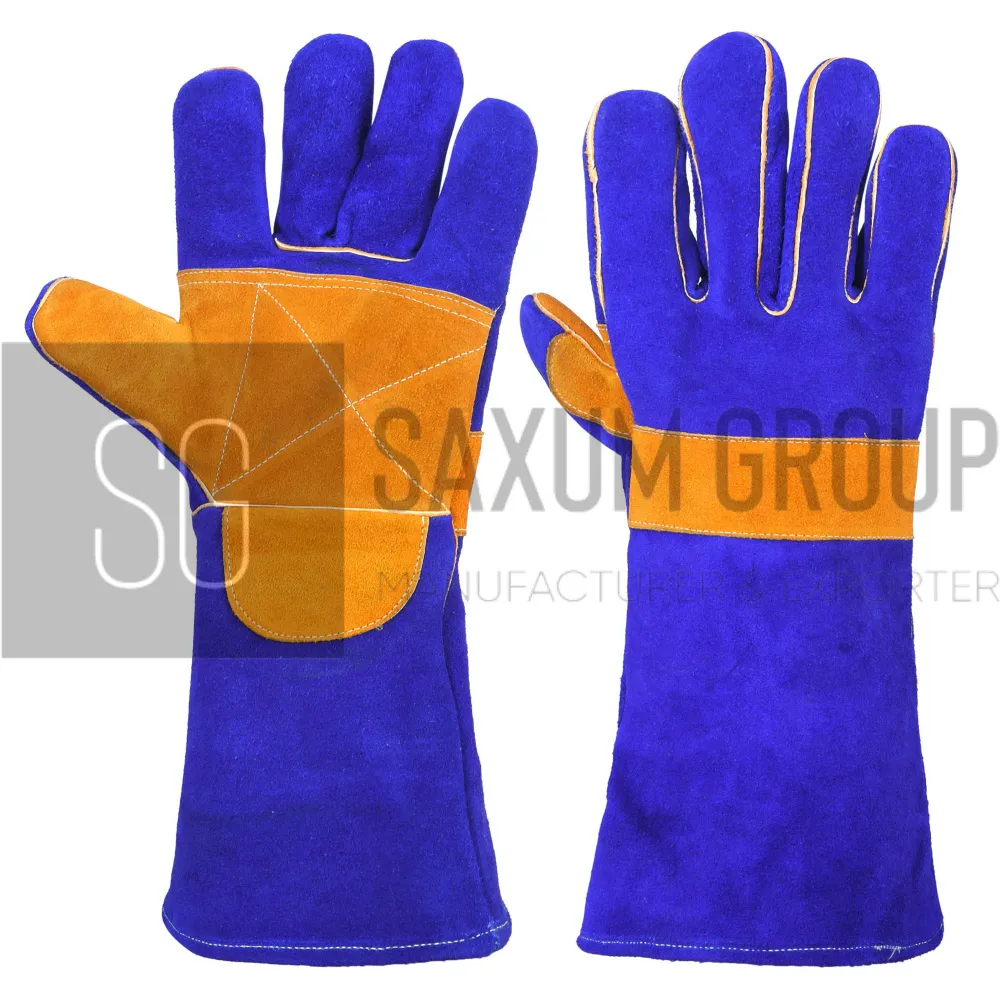
MIG welding is fast, it’s forgiving, and it’s where most welders spend their day. That’s also why MIG welding gloves wear out faster than almost any other glove in the shop. The hand sits close to a hot, bright arc for hours, spatter lands on the back of the glove, and the palm rubs on the gun handle with every bead. A glove that’s too thin burns through in a week. One that’s too thick makes the trigger finger useless.
We make leather MIG welding gloves in Sialkot, Pakistan, for distributors, safety suppliers and private label brands in the USA and Europe. This guide covers what a good MIG glove is actually built from, how the welding process changes what you need, and what to check before you order MIG welding gloves in bulk.
The short answer
- Most MIG welding gloves are split cowhide gauntlets with a lined back of hand, a cuff of about 13 to 14 inches, and Kevlar thread.
- Higher amps, spray transfer and flux-cored wire mean more heat and spatter, so they need a thicker, better lined glove.
- Look for a reinforced palm and thumb, welted seams, and a lining that stops at the fingers so you can still feel the trigger.
- In Europe, welding gloves are tested to EN 12477. Type A is the higher protection grade that suits MIG and stick welding.
What Makes MIG Welding Hard on Gloves
MIG sits between TIG and stick. It’s hotter and messier than TIG, but cleaner than stick. Our TIG vs MIG vs stick welding gloves comparison covers all three side by side. Here we’ll stay on MIG, because the details are what decide whether a glove lasts.
A MIG glove deals with four things at once:
- Radiant heat and UV from the arc. The back of the hand faces the arc for long stretches. Over time, that heat dries and stiffens the leather on the back long before the palm wears out.
- Spatter. Small balls of molten metal land on the fingers and back. Each one leaves a scorch mark, and on thin leather or cotton thread they eventually burn through.
- Contact heat. Welders rest their hand on the work, pick up tacked parts and move the gun nozzle by hand. That’s direct heat into the palm.
- Abrasion. The gun handle, trigger and steel edges wear the palm and the inside of the thumb every day.
A good MIG welding glove is a balance of all four, with enough feel left over to work the trigger and guide the gun for a full shift.
How the MIG Process Changes the Glove You Need
“MIG” covers several different ways of running wire, and they aren’t equally hard on gloves.
| MIG setup | Heat and spatter | A sensible glove |
|---|---|---|
| Short-circuit MIG on thin steel | Lower heat, light to moderate spatter | Medium split leather glove, lined back, shorter gauntlet |
| Spray transfer on thicker steel | High heat and strong radiant glare | Thick lined split leather gauntlet, foam or felt on the back |
| Flux-cored wire (FCAW) | Heavy spatter and smoke, close to stick welding | Heavy lined gauntlet, welted seams, reinforced palm |
| Aluminum MIG | Very high heat reflecting off the work | Well insulated gauntlet with a heat-blocking back |
| Stainless and light fabrication | Moderate heat, more fine work | Lighter glove with better feel, or a heavier TIG-style glove |
So when a buyer asks for “MIG gloves”, the first useful question back is: what amps, what wire, and how many hours a day? A fabrication shop running flux-core all day needs a different glove from a body shop doing short tacks on sheet metal.
Leather Choices for MIG Welding Gloves
Almost every MIG glove on the market is leather, and for good reason. Leather doesn’t melt. It chars and stiffens, which gives the welder time to react. Synthetic fabrics can melt onto the skin.
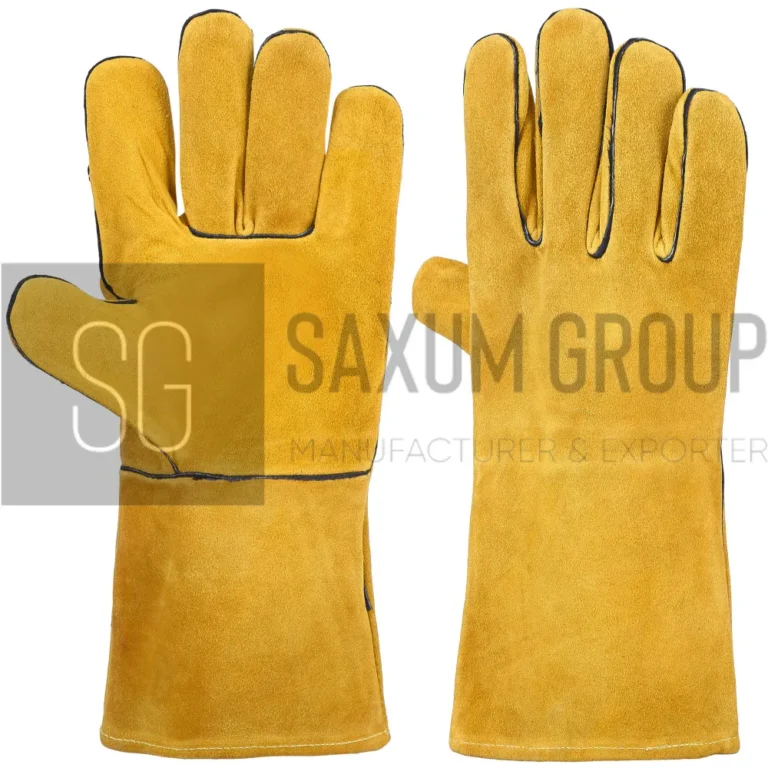
- Split cowhide is the standard. It’s thick, fibrous and holds a lot of air, which makes it a good insulator. It’s also affordable, which matters for a glove that gets replaced often. Most of our leather welding gloves for MIG and stick are split cowhide.
- Grain cowhide is smoother and more resistant to abrasion, with better feel. It costs more and insulates a little less at the same thickness, so it’s used in premium MIG gloves or on the palm only.
- Goatskin is soft and flexible, great for TIG, but on its own it’s usually too thin for heavy MIG. Our cowhide vs goatskin work gloves guide explains the difference.
- Pigskin and deerskin show up in some MIG gloves, deerskin for comfort and pigskin because it stays soft after getting wet. They’re less common, and cowhide is still the default for MIG.
Thickness matters more than most buyers expect. Two gloves can look the same in a photo and differ by 0.3 mm of leather, which is the difference between a glove that lasts a month and one that lasts a week. Ask for the thickness in writing. Our split vs grain leather gloves guide goes deeper on how each leather behaves.
Construction Details That Make a MIG Glove Last
Lined back, lighter fingers
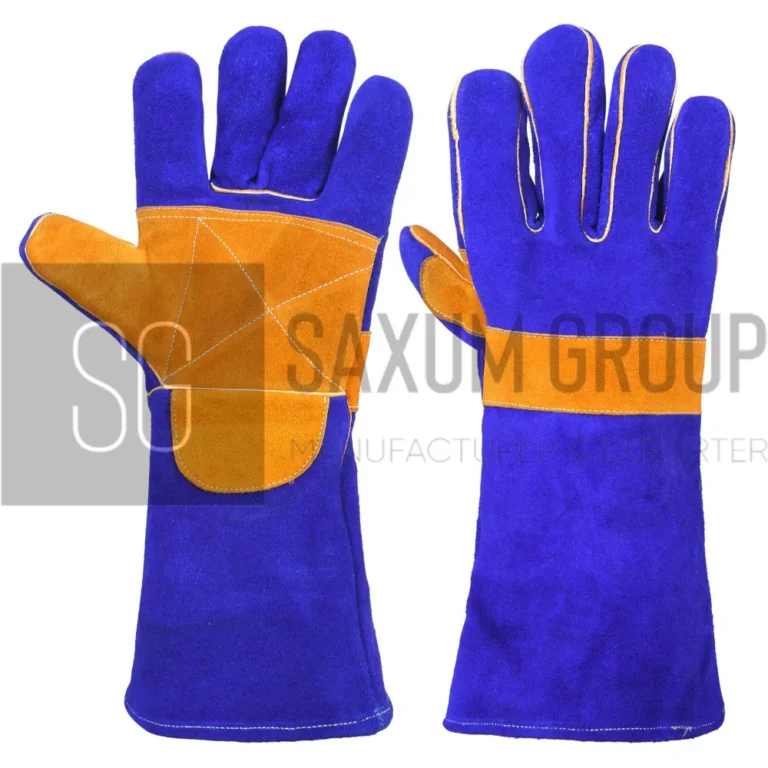
The back of the hand takes the most radiant heat, so better MIG gloves put a foam, felt or fleece lining there. The fingers are often unlined or lightly lined, so the welder can still feel the trigger. A glove that’s heavily lined everywhere is warm and safe but tiring to work in.
Reinforced palm and thumb
An extra layer of leather across the palm and up the thumb crotch adds both life and insulation, because that’s where the gun handle rubs and where the hand rests on hot work. The same idea is behind double palm work gloves.
Kevlar thread and welted seams
A MIG glove usually fails at the seams before the leather goes. Cotton thread chars, and polyester melts. Kevlar thread keeps its strength near heat, so it’s worth putting in the spec. A welt (a narrow strip of leather sewn into the finger seams) protects the thread from spatter and wear.
Cuff length
MIG gloves are usually gauntlets of 13 to 14 inches. That covers the wrist and the gap under the jacket sleeve, where spatter likes to drop in. For overhead work or heavy flux-core, 16 inches or more is safer. Our welding glove length guide explains how to choose.
Straight thumb vs wing thumb
A wing thumb is cut as part of the palm and gives a more natural grip on the gun with fewer seams in the wear area. A straight thumb is sewn in separately and is simpler to make. Both work. Ask for a sample of each if your customers have a preference.
MIG Welding Glove Standards: EN 12477 and EN 407
If you sell into Europe, or to US buyers who ask for tested gloves, two standards come up again and again.
- EN 12477 covers protective gloves for welders. It splits them into Type A, with higher heat and spatter protection but less dexterity, and Type B, with more dexterity and less protection. MIG and stick gloves are usually Type A. TIG gloves are usually Type B.
- EN 407 rates heat and flame performance across six tests, including contact heat and small molten metal splashes. Our guide to heat resistant leather gloves explains what each digit means.
There’s no single US welding glove standard. Many US buyers ask for these European ratings, or for cut ratings under ANSI/ISEA 105, which our ANSI cut levels guide covers. If you need certified gloves, plan for lab testing at the sample stage, not after the bulk order.
How a MIG Welding Glove Should Fit
A loose MIG glove slides on the gun handle and makes the trigger finger clumsy. One that’s too tight pulls the leather thin across the knuckles, which is exactly where heat gets through. Most welders wear their normal size in a MIG gauntlet, and some go up one size for a glove they can shake off fast if a spark gets inside. Our work glove size chart shows how to measure.
Why MIG Welding Gloves Wear Out (and How to Make Them Last)
- Burnt-through fingertips. Usually thin leather or the hand resting too close to the puddle. A reinforced fingertip or a heavier glove helps.
- Hard, shrunken backs. That’s radiant heat drying the leather. A lined back slows it down, and so does letting gloves dry slowly instead of on a hot surface.
- Split seams. Almost always cotton thread or unwelted seams. Switch to Kevlar thread.
- Worn palms. Normal on a hard-working glove. A palm patch adds weeks of life.
Our guide on how to clean leather work gloves covers drying and conditioning so the leather stays soft longer.
What to Put in a Spec for Bulk MIG Welding Gloves
If you’re a distributor or a brand building your own welding range, these details make the difference between a good glove and a cheap copy:
- The process and amps your customers use (short-circuit, spray, flux-core, aluminum).
- Leather type and thickness for the palm, back and cuff.
- Lining material and where it goes: full hand, back only, or palm and back.
- Kevlar thread, welted seams, and any palm or thumb reinforcement.
- Cuff length and color, plus the size run (S to XXL is common in the USA).
- Any standard you need (EN 12477 Type A, EN 407) and who pays for testing.
- Your logo, labels and packaging. Our custom logo work gloves guide covers the options.
Then get samples and give them to real welders for a week. A MIG glove only proves itself on the shop floor.
MIG Welding Gloves: Frequently Asked Questions
Can I use MIG welding gloves for TIG welding?
You can, but most TIG welders won’t like it. MIG gloves are too thick to feel the filler rod. TIG gloves are thin goatskin or grain leather built for control. See our TIG welding gloves for the difference.
Can I use TIG gloves for MIG welding?
For short, light MIG work, yes. For long runs, high amps or flux-core, no. A thin TIG glove will heat up fast and burn through.
Are stick welding gloves better than MIG welding gloves?
Stick gloves are usually heavier and longer, built for even more spatter. They’ll protect well for MIG too, but you give up feel on the trigger. Many shops use one heavy gauntlet for both stick and flux-core MIG.
How long should MIG welding gloves last?
It depends on hours and amps. A full-time welder might go through a pair every few weeks, while a hobby welder can get a year or more. Kevlar thread, a lined back and a palm patch all make a real difference.
What color MIG welding gloves sell best?
Natural grey, gold and blue split leather are common choices, and two-tone gauntlets help a brand stand out on the shelf. Because we make to order, the color and trim are your choice.
MIG Welding Gloves From Our Range
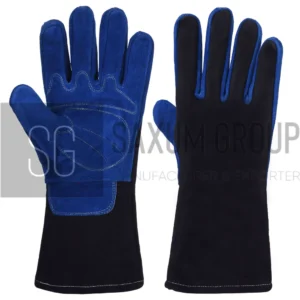
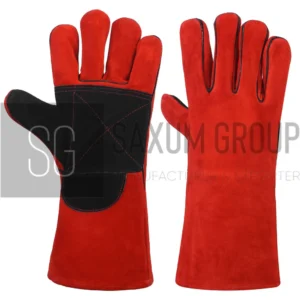
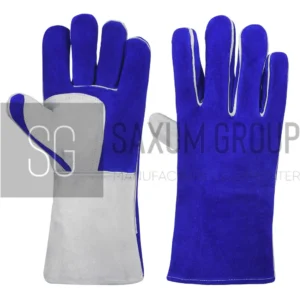
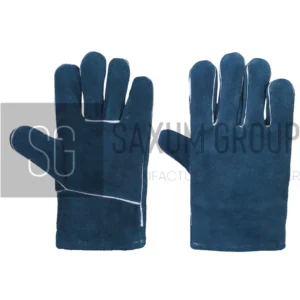
See all leather welding gloves →
Doing stick as well as MIG? Our guide to stick welding gloves shows when one heavy gauntlet covers both and when a dedicated stick glove is worth it.
For the numbers behind heat protection, see what temperature welding gloves can withstand and what the EN 407 contact heat levels mean.
MIG Welding Gloves Made in Sialkot, Pakistan
Saxum Group makes MIG and stick welding gauntlets, TIG gloves and welding clothing in our own factory in Sialkot. As a welding gloves manufacturer in Pakistan, we can match your sample or build a MIG glove to your spec: leather, lining, thread, cuff, colors, logo and packaging, through our private label service. Send us a photo or spec on our contact page and you’ll get a quote within 24 hours. New to buying from here? Our guide to importing work gloves from Pakistan walks buyers in the USA through the process, and our wholesale work gloves supplier guide lists what to check before you order.